

[USGS Banner]
[Solar System] [Missions] [Technology] [Data & Information] [Research] [Hot Topics] [Gallery] [About Us] [Search] [Kids' Zone]
 [end navigation bar]
Menu Menu Menu Menu Menu Menu Menu Menu Menu Menu Menu Menu


USGS Astrogeology & the Cassini-Huygens Mission


Introduction

Several scientists, engineers, and specialists in the USGS Astrogeology Research Program are participating in the Cassini-Huygens Mission to Saturn and Titan under the direction of Laurence A. Soderblom, Randolph L. Kirk, and Brent A. Archinal. The involvement of Astrogeology in the Cassini-Huygens Mission began long before the mission's launch in 1997.

Cassini-Huygens is an international collaboration between three space agencies. Seventeen nations contributed to building the spacecraft. The Cassini orbiter was built and managed by NASA's Jet Propulsion Laboratory. The Huygens Probe was built by the European Space Agency. The Italian Space agency provided Cassini's high-gain communication antenna. More than 250 scientists worldwide, including many in the USGS Astrogeology Research Program, will study the data collected.

General information about the Cassini-Huygens Mission to Saturn and Titan can be found on the Cassin-Huygens Mission website.

Press kits and other useful information for the media can be found on the above website in the For News Media section.


Pre-launch Contributions

Planning for mission cartography depends on numerous maps created by Astrogeology of several of Saturn's moons using image data collected by the Voyager missions of the 1970's. Image mosaics and airbrush shaded relief maps can be found on the Saturn Satellites - Voyager Global Image Maps web page.

Astrogeology staff members have been involved in the mission for over ten years, assisting in planning, integration of research teams, instrument design and development, and identifying objectives. Laurence A. Soderblom co-chairs the Cassini Surfaces Working Group. Randolph L. Kirk is the chair of a subgroup focusing on satellite cartography.

Jupiter/Io Fly-by

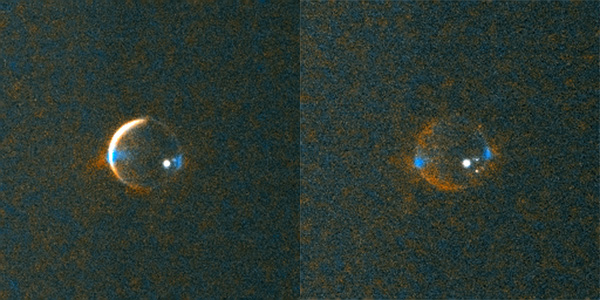
As the Cassini spacecraft passed through the Jovian system on its way to Saturn, it captured more than 500 images of Jupiter's moon Io in eclipse. Cassini's near-ultraviolet filters detected the moon's bright equatorial glows, supporting the interpretation that the visible emissions are predominantly due to molecular sulfur dioxide (SO2). Detailed comparisons of laboratory SO2 spectra with the Cassini observations indicate that a mixture of gases contribute to the equatorial emissions. A summary of Astrogeologist Paul Geissler's investigation, images and animations of the aurorae phenomena on Io witnessed by Cassini, and information about the upcoming publication in Icarus can be found on the Cassini Observations of Io's Visible Aurorae web page.


Huygens Probe

The Huygens Probe will separate from the Cassini orbiter on December 24, 2004 and descend into Titan's atmosphere on January 15, 2005. During its 2.5 hour descent, Huygens' Descent Imager/Spectral Radiometer (DISR) will capture more than 1,100 images, while the probe's other five instruments will sample Titan's atmosphere and determine its composition. As the probe descends, it will spin at approximately 7 rpm. The cameras on the probe are arranged to collect views of the surface and horizon, allowing a wide area around its trajectory to be imaged. Astrogeology will create image maps, stereoscopic image products, and topographic maps using these images, giving other mission scientists the cartographic information needed to determine where the probe was located when data were collected. This effort is led by Brent A. Archinal. In addition to the descent imager and various other instruments that will collect data about the atmospheric content, temperature, and pressure, the probe also carries a surface science package with sensors for studying Titan's surface after landing.

When available, information and research results will be linked on the USGS Astrogeology Cassini Mission page.

For more information about the Huygens probe, see the ESA Cassini-Huygens website.


Cassini Orbiter

Astrogeology is also participating in work involving the Cassini orbiter instruments, contributing to the work being done with the data collected by the Visible and Infrared Mapping Spectrometer (VIMS), Imaging Science Subsystem (ISS), Ultraviolet Imaging Spectrograph (UVIS), and Radio Detection and Ranging Instrument (RADAR).

When available, information and research results will be linked on the USGS Astrogeology Cassini Mission page.

Laurence A. Soderblom serves as an Interdisciplinary Scientist for the mission, working to integrate the research being done by scientists specializing in a wide variety of fields to better understand the history, characteristics, composition, and physical processes of the surfaces of Saturn's icy satellites using the VIMS, ISS, and RADAR instruments.

While all the icy moons of Saturn are of concern to researchers, of particular interest are the moons Titan, Enceladus, and Iapetus. Titan, the largest of the moons, is the target of the Huygens Probe. Enceladus, the second largest satellite of Saturn, has very bright, young surfaces - it has the highest albedo of all the bodies in the Solar System - leading scientists to believe the satellite was active until quite recently, and possibly is still active today. Due to this activity, Enceladus is potentially the source of material in Saturn's E ring. Scientists are also fascinated by Iapetus, which has a bright side and a dark side. The trailing hemisphere (the one facing away from its direction of motion) is almost black, while the leading hemisphere is quite bright. Also puzzling is that the dividing line between the two sides is quite sharp. It's unknown if the leading hemisphere was dusted with material knocked off of the outermost satellite, Phoebe, or if there's a process on Iapetus responsible for this unusual characteristic.

RADAR

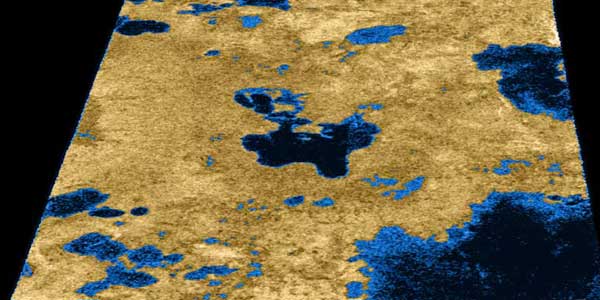
The RADAR instrument will use the dish antenna, also used by Cassini to transmit its observations to Earth, to beam radio pulses at the cloud-shrouded giant satellite Titan and receive the echoes in order to map the surface topography. Additionally, the RADAR instrument is able to detect thermal radiation emitted naturally from Titan's surface. Randolph L. Kirk is a member of the Cassini RADAR Science Team whose main focus in the mission will be observing, mapping, and modeling the surface features revealed by the RADAR. A key tool for this effort will be the ability to produce topographic maps from the RADAR images by stereo and shape-from-shading analysis. Astrogeology will also support the RADAR Team by developing processing and analysis software, creating image mosaics and maps of Titan's temperature and chemical/physical properties, generating topographic models, and disseminating data and products to mission team members, to the public, and to NASA's Planetary Data System for archiving.

For more information about the RADAR instrument, see the Cassini website.

ISS

The Imaging Science Subsystem (ISS) captures images in visible, infrared, and ultraviolet light. ISS includes two cameras; a Wide Angle Camera (WAC) and a Narrow Angle Camera (NAC). Both cameras are fitted with spectral filters that rotate on a wheel -- to view different bands ranging from 0.2 microns to 1.1 microns. The cameras will observe the surfaces of the moons orbiting Saturn and possibly discover new moons in addition to studying Saturn and its rings.

For more information about the ISS instrument, see the ISS science team's website.

VIMS

The Visible and Infrared Mapping Spectrometer (VIMS) has two cameras, one to measure visible wavelengths, the other infrared. VIMS data will be used to learn more about the composition of satellite surfaces, the rings, and the atmospheres of Saturn and Titan, and to study the ring structure. VIMS is designed to measure reflected and emitted (thermal) radiation from atmospheres, rings and surfaces over wavelengths from 0.35 to 5.1 micrometers. It will also help determine the compositions, temperatures and structures of these objects.

For more information about the VIMS instrument, see the VIMS science team's website.


In the Media

Time Magazine, July 12, 2004: Larry Soderblom is one of several scientists and other mission participants interviewed for an article on the Cassini-Huygens Mission. The Time Magazine article on Cassini is available on Time's website to subscribers.


For information, contact:

Larry Soderblom
Geologist
lsoderblom@usgs.gov
2255 N. Gemini Drive
Flagstaff, AZ 86001
(928)556-7018

Randolph L. Kirk
Geophysicist
rkirk@usgs.gov
2255 N. Gemini Drive
Flagstaff, AZ 86001
(928)556-7020

Brent A. Archinal
Geodesist
barchinal@usgs.gov
2255 N. Gemini Drive
Flagstaff, AZ 86001
(928)556-7083


Return to the USGS Astrogeology Research Program Home