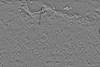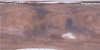



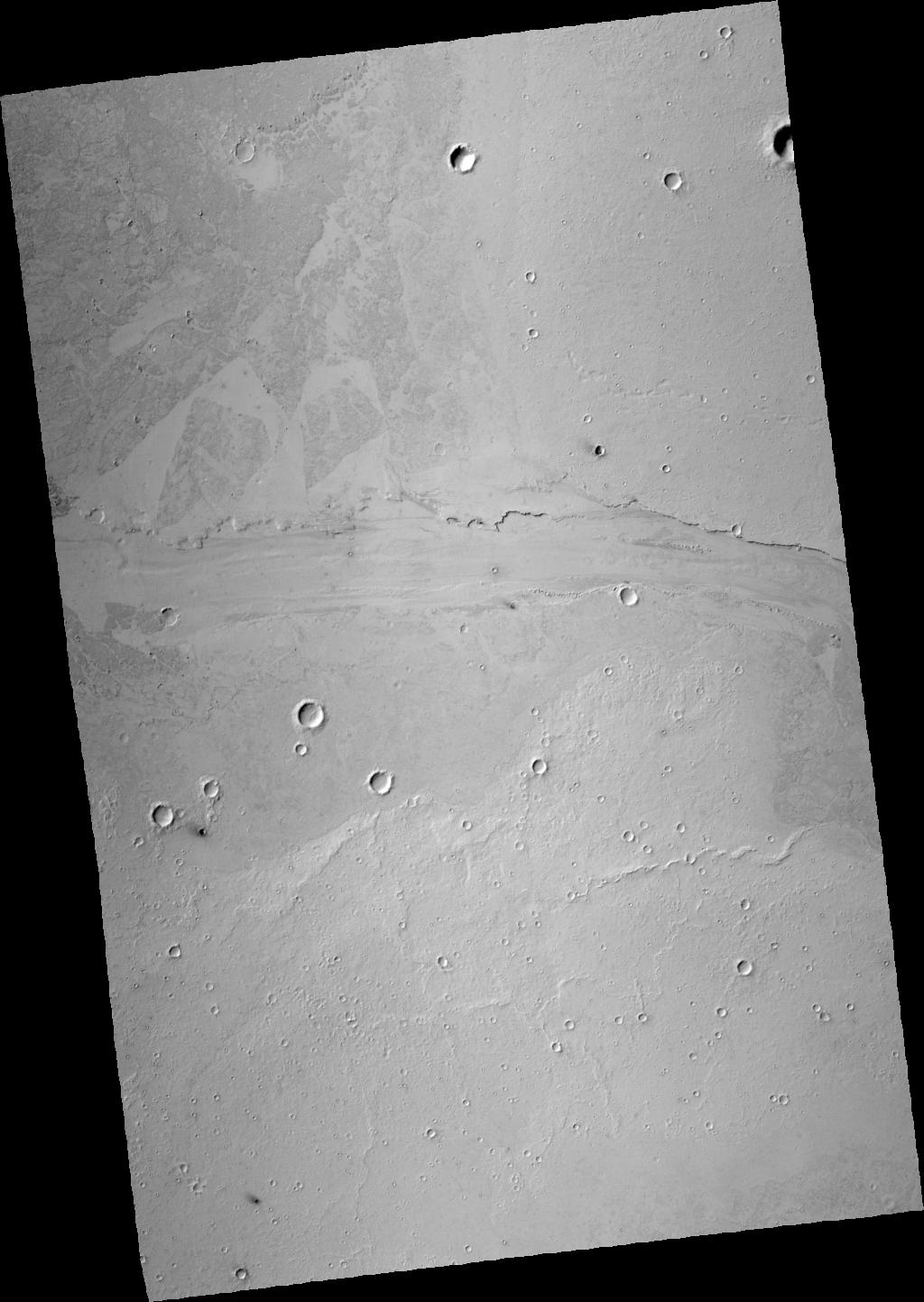
CTX Orthoimage of Lethe Vallis
- Primary Authors
- Colin M. Dundas
- Originators
- Colin M. Dundas, Glen C. Cushing
- Publisher
- USGS Astrogeology Science Center
- Publication Date
- 2018-04-09
- Abstract
- This orthorectified image was created by projecting an image from the Mars Reconnaissance Orbiter Context Camera (CTX) onto a Digital Terrain Model (DTM). The DTM is available under the âDerived Fromâ section on the right of this page.
- Purpose
- This orthoimage was produced to understand the properties of large lava flows on Mars.
Contact and Distribution
- Format
- Digital Elevation Model, Raster Data
- Access Constraints
- Public Domain
- Access Scope
- Edition
- 1
- Native Data Set Environment
- GDAL, ISIS v3
- Astrogeology Theme
- Photogrammetry, Topography, Volcanism
- Mission Names
- Mars Reconnaissance Orbiter
- Instrument Names
- CTX
- Online Package Link
- https://astrogeology.usgs.gov/search/map/ctx_orthoimage_of_lethe_vallis
- External File Size
- 35 MB
- Online File Link
- https://planetarymaps.usgs.gov/mosaic/dundas_flood_lavas_topo/B01_009900_1837_XN_03N206W_6m_o.tif
- Contact Address
- 2255 N. Gemini Drive
- Contact City
- Flagstaff
- Contact State
- AZ
- Contact Postal Code
- 86001
- Contact Email
- [email protected]
- Currentness Reference
- Publication date
- Progress
- Complete
- Update Frequency
- None planned
- Process Description
- The DTM processing work-flow consists of the following steps: (1) Automatically generate and place tiepoints in the stereoimages and perform a relative adjustment to bring the images into alignment (2) Create a low resolution (typically 100 m/post) DTM from the relatively adjusted stereopair (3) Absolutely control the low resolution DTM to the available reference data (MOLA, or HRSC) using the Ames Stereo Pipeline program pc align (4) Apply the transformation to the ground coordinates previously calculated for the tiepoints, placing them in alignment with the reference (5) Perform a final adjustment with the tiepoints converted to XYZ points at their transformed locations (6) Perform interactive quality control and editing to remove artifacts introduced in the matching step (7) Export the final DTM and orthorectified images NOTE: Some artifacts may remain even after editing.
- Source Title
- CTX
- Source Online Linkage
- http://pds-imaging.jpl.nasa.gov/volumes/mro.html
- Source PDS Archive
- Mars Reconnaissance Orbiter
- Horizontal Positional Accuracy Report
- Accurate to Control Net
- Vertical Positional Accuracy Report
- Accurate to Control Net
Geospatial Information
- Target
- Mars
- Minimum Latitude
- 3.4020114570171
- Maximum Latitude
- 4.1341816355312
- Minimum Longitude
- 153.56900816
- Maximum Longitude
- 154.08849324
- Direct Spatial Reference Method
- Raster
- Object Type
- Grid Cell
- Raster Row Count (lines)
- 7149
- Raster Column Count (samples)
- 5072
- Bit Type (8, 16, 32)
- 8
- Quad Name
- Radius A
- 3396190
- Radius C
- 3376200
- Bands
- 1
- Pixel Resolution (meters/pixel)
- 6.0707952527584
- Scale (pixels/degree)
- 9763.90984301
- Map Projection Name
- Equirectangular
- Latitude Type
- Planetocentric
- Longitude Direction
- Positive East
- Longitude Domain
- 0 to 360